Saturday, February 7, 2009

Out of Water

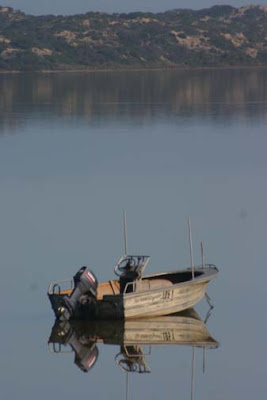
The bund between Lakes Alexandrina and Albert, on 22nd Jan 09 (western calendar).


During the record heatwave at the end of Jan-beginning of February and strong winds, a marked difference is seen. Images 5th February 09:


The bund, we were told in April 08 by the SA Govt, would be "temporary" for 6 months.
Thirteen "temporary" pumps were replaced by 3 "permanent" pumps. Now there are 6, pumping day and night.


The record heatwave conditions, we are told, is responsible for the increased pumping from Lake Alexandrina into Lake Albert to avoid its ecological collapse.

Notice the colour of the water being pumped.


On still nights, reverberations from the pumps echo across the lake. The constant jerky low frequency sound is torturous and is causing sleep deprivation for this resident of Narrung.


It is estimated that the cost of pumping so far is $14-18 million.
Yet natural revegetation along the lake's shore line shows that the predicted acidification in Lake Albert could be remediated without needing costly, noisy, fumy sleep depriving pumps.


Despite 47° heat, the local Mimulus survives and keeps flowering.


Silt is accumulating around the bund.


A stagnant pool of water is trapped by build-up of silt beside the bund.


The bund is already showing serious cracks and subsidence.


With all the pumping and silting, the Narrung Ferry is out of water to cross.


Diving off the Narrung jetty is no longer advisable.


Willows growing at the Narrung Ferry approach are out of water.


Introduced weed species, feathers, corpses, cracks are
salient signs of the environmental distress.


Silts, showing high levels of salinity, have been dumped
on habitat where Australian otters and swamphens used to live.
What is likely to grow here?


When the wind blows, dust from the Narrung wetlands fills our gutters. Frequent cleaning is causing costly repairs. A local doctor suspects drinking water of Narrung residents has been contaminated by the dust, causing health problems.


In 2008, environmental work was carried out to help restore the Narrung wetland. Due to lack of flows down the river it is now dust,
gone the swans, spoonbills, stilts, sandpipers, egrets, terns and frogs.


The lower lakes and Coorong, the lungs of the River Murray, maintained by the Ngarrindjeri for thousands of years as an abundant delta, supporting the densest pre-Invasion population on this continent, are now being sacrificed to the greed of the Australian nation. Shame!


pics: © Vesper Tjukonai Feb 2009

Thursday, August 28, 2008

REQUIEM FOR THE LAKES AND COORONG?

At Raukkan the sands are strewn with old leather heels, presumably from the boots of Ngarrindjeri wool-washers. Along the lake's rim, five thousand year old stone circles of Ngarrindjeri fish-farming are being scattered by grazing cattle. “What pretty rock formations,” said a local, ignorant of Ngarrindjeri heritage. Grimmer is the exposure of remains from Ngarrindjeri burial grounds around the lakes. The cultural and economic impact on Ngarrindjeri communities is profoundly distressing.

In the 12 years I've lived at Narrung, the church has closed, then the general store and petrol pump, and then the school. It's likely the police station will close soon, and also the ferry too, adding 70 odd kms on the journey to the nearest major centre. Loss of viable habitat, loss of livelihoods, loss of relationships has impacted severely on this community. Instead of the gentle sound of swans of an evening, I hear the mechanical drone of pumps: artificial life support for Lake Albert.

"This peninsula must have been a Paradise for the Aborigines of long ago," observed E. Leta Padman, "with all the variety of food so readily available." "Those who are here today can never realize the condition of this country in the early days. Kangaroos abounded in the thousands," reminisced a Mr Hacket. The "numerous tortoises" Padman describes around 1987 "trundling across the roads and paddocks from the water to higher ground," are now a rare sight and even then they are likely to be encrusted with killer marine worms. "Today the travellers through Narrung can feast their eyes on a great variety of birds," wrote Padman. [The Story of Narrung: the place of large she-oaks, c1987, p24] No more. There has been an 85% reduction in the number of seasonal migratory birds, said Dr Arlene Buchanan of the Australian Conservation Foundation recently.

“Over ten years ago ... a group of us Aboriginal people took the people right through the old waterways and showed them the courses where the water came ... and they suggested to us that they didn't have any time to listen to old Aboriginal stories and that really crushed us way back then. And ever since then, it's been receding ever since,” observed Ngarrindjeri Rupulli George Trevorrow.

"Irreversible ecological collapse,"says the Australian Conservation Foundation, is the "only option" to not bringing flows down the river. Without urgently needed flows it will be "a toxic waste dump." [Josie Taylor. "Govt says the Murray's Lower Lakes can't be saved."06/08/2008. http://www.abc.net.au/lateline/content/2008/s2326382.htm]

The state of the Lower Lakes and Coorong is "an act of monumental environmental vandalism without precedent in Australian history," observed Greg Hunt, SA's opposition Environment spokesperson. He pointed out that Australia is perilously close to becoming "only the second Government in the world to have presided over the destruction of a Ramsar listed wetland." The first was led by Iraq's Sadam Hussein.

Upstream Dr Jennifer Maharosy warns of “a potential economic and social catastrophe” if measures are not implemented to “keep the river full of water.” Maharosy claims that if "a permanent weir" were built "just upstream of the lakes at Wellington,” there could be "water savings in the order of 750,000 megalitres a year.” She advocates that barrages be opened, allowing the Lower Lakes and Coorong to be flooded with sea-water. [“Barrages Block Sense.” http://www.jennifermarohasy.com/articles155.html]

But local expert Dr Muller suggests that tidal flow through the mouth would not have enough energy to flush the lakes, "leaving vast areas of acidified wasteland." She also warns that "rapid conversion to salinities of seawater" might result in the contamination of "some 100,000 ha," making the region "uninhabitable" and "requiring the permanent retiring of productive land, both irrigated and dryland, and possible evacuation of lakeside communities."

According to a lower lakes irrigator and the Australian Conservation Council a 10-15% reduction of all water allocations in the Murray Darling Basin would let enough water flow down the River for both consumptive needs and restorative environmental flows.

It has been hard to write this without feeling overwhelmed by distress. In 2008/9 are we writing arequiem for the Coorong and the lower lakes?

The recent winter rains have been an answer to prayer and the drought-grey sands have sprung alive with green. Whether the lower lakes and Coorong survive, and the Murray-Darling too, is dependent not just on water flows, but on people behaving better towards Mother Earth and Her waters than they have in the past two centuries.

A Ngarrindjrei elder guided our craft up the Coorong. Although it was deep night, we could make out the curves of the tea-tree and coastal wattle on the dunes. An oyster-catcher called from the south, a shrill “Peep-peep. Peep-peep.” Another joined in: “Per-peep, per-peep.” “Come here! Come here! This way,” it seemed to say. Above us, the veil of cloud thinned. We caught a glimpse of the moon and a handful of stars, and as if waiting for us, the black and white form of our haunting feathered songster. The water around us sparkled. “Put your hand in,” Paul directed. We did and were surprised with an electric shock. How? Why? In and out, we playfully dipped our hands and every time got zapped. This stretch of the water looked the same as anywhere else, and yet it held, 'scuse the pun, a shocking secret. Further on, Paul told us to jump out of the boat. We rolled up our trouser-legs and hoisted ourselves overboard. Splash! Black water came alive with sparks of light: another magical surprise. “Phosphorescence,” our Ngarrindjeri guide explained.

I don't want experiences like this to be lost to our children. Let's put aside our private interests and invest in the Life and Health of the River.

In the words of Storm Boy's author Colin Thiele:

“It is good that some people have known the Coorong and loved it for what it once was -for its untouched beauty, its light, its elemental naturalness,its peace and isolation,for it may soon be destroyed, is already in danger of being destroyed – trampled to death by the modern sacred cows of tourism, development and recreation. [excerpt from“The Coorong”]


If Australia allows this region to die, the consequences, the shame of it, will hang around this nation's neck like a dead albatross. But better, much better is to revitalize the Swan the Ngarrindjera know in the form of the Lower Lakes and Kurangk; so Swan can sing us all to thrive.

"May our Spirits find rest and peace within our Lands and Waters." [Kungun Narrindjeri Miminar Yunnan]

HEALTH, WEALTH, WORDS AND THE RIVER


Words are a mirror to human experience. The meaning of the English words such as “health” and “wealth” have altered over time, reflecting changes in society.

Today a healer is largely thought of as some kind of charlatan. However, “heal” comes from the Old English hælan, to make whole, says John Ayto. Health professionals are realizing that getting people healthy isn't a matter of treating symptoms, but of balancing a whole series of inter-relationships: family, work, lifestyle, environment, exercise, nutrition. Healthy behaviour takes account of the needs of the whole body, physical, economic, cultural, and spiritual.

“Health”comes from the Old English hælþ “wholeness.” "Health" is "heal" with the addition of þ (th), the Norse þurisaz or Anglo-Saxon þorn rune of transformation. Þurisaz is a very ancient name for Thor, says author Freya Aswynn. [Leaves of Grass, a synthesis of runes, gods, magic, feminine mysteries and folklore] In Norse accounts of Creation, Thor kept giants, representing "the forces of chaos," in their place. In the Norse tradition, Thor, also known as Jord, son of the earth goddess, cares for the land, brings life to the frozen Gerd, earth, and defends the people of the land. People who care about the environment ‘would do well’ to invoke the aid of þ Thor, suggests Aswynn. Thor, in the form of the þ rune, protected Anglo-Saxon rituals honouring life's passages. Bath, birth, strength, hearth, death: English perpetuates Thor's protection by retaining those Anglo-Saxon þ words. Like water, the þ rune is a carrier. It supplies life force, energy and focus to make things happen, says Aswynn. Add þ and you get ‘action,’ advises Edred Thorsson.[Futhark, A Handbook of Rune Magic]


"Time to Act on River Murray" urged the headline of the 8th August Lakelander, local paper for people living around the Lower Lakes and Coorong. "A river system needs to flow from its head to the sea ..." explained "lakes and Coorong Expert" Dr Kerri Muller. "Action is needed now," was the cry in the next issue. [D John Boundy, "Water, Water Everywhere and Not a Drop to Drink." The Lakelander,15th August.] If we focus on the health of the Murray-Darling, from the mountains to the sea, it is more likely to return wealth to the region, than by implementing more hoarding measures, the dire consequences of which can be predicted by past failures.

In the English word family, “health” “heal,” “whole,” “holy” and “Halloween” are cousins. This word family, which links physicality, spirituality and culture, finds common ground with MLDRIN, the call by First Nations along the River for holistic and respectful actions. And perhaps the drought is healing: the desperate lack of water reminds us that the river is not a “resource” but a sacred “source” of life.

“Wealth” which now is mostly thought of in term of economic value, comes via the Middle English wele "well-being," from the Old English wela "wealth, welfare, well-being." It and the “wealth” of “Commonwealth” ultimately derive from the proto Indo-European base *wel- "to will," says Douglas HArper [Online Etymological Dcitionary] What is needed for a wealthy river is a common will to look after its well-being and welfare.

It is to be hoped that the formation of the single Murray Darling Authority will produce healthier behaviour in the Murray-Darling Basin than the constitutional water right of states and landholders. It is to be hoped that the Federal Government will moderate vested interests. Its $400 million buy-back of water entitlements in the northern basin, including $350million in Queensland, is a start. It is to be hoped that this will encourage the wider community to behave coherently for the health, wealth and healing of the river. And already this appears to be happening: Victoria's Murray River Group of Councils recently supported the MDA in taking "an holistic approach to the national crisis including the whole Murray Darling Basin."[Murray River Group of Councils, July 2008, "Communique," http://www.campaspe.vic.gov.au/hardcopy/111751_188338.PDF.]

As the water dwindled around the eroding crannies of the Narrung Peninsula, local dairy farmers, Cathie and David Harvey, didn't wait for the government to act. They saw the need for an holistic approach and implemented biological farming practices. These work with the "natural processes" occurring on a farm. Rather than treating the symptoms with pesticides and inorganic fertilizers, biological farming addresses the cause of any problems. It pays attention to the biota that makes soil healthy, and prefers to optimize "soil, plant and animal health." And healthy soil produces more nutritious food. ["Introduction to Biological Farming" http://www.bioag.com.au/improving_natural_soil_fertility/biological_farming/]

"Biological farming reduces soil leaching and retains soil moisture," observed Cathie. In a record drought, the Harveys harvested a lucerne crop last year and they milk two hundred cows each day.

The Narrung Peninsula elsewhere is described by reporter Shane Strudwick as a "series of vacated dairies that have been mothballed." He lamented: "Families are leaving the region and quality drinking water needs to be trucked in with no subsidies or support from the government."["Australia’s True Catastrophe happening now." 17.3.08. http://rivermurray.com/petition/drought-tour/] In contrast, the Harvey's health-promoting methods demonstrate a staying power that is to be respected. Producers in Australia's food bowl upstream would do well to follow the Harvey's lead and implement biological farming practices.

"A healthy river is essential to ensure that future generations of Australians can enjoy the same quality of life as past generations," asserts the Indigenous Response to the Living Murray initiative. "The river is a place of healing. It provides a place of balance and relief from stress and sickness," came the consistent response to the question: "What is the significance of the River Murray to you?"

"The river is critical to health and welfare."

"The river has major economic importance. It is a source of food, fibre, water, medicine and other sustenance."

"The river is part of song and storylines."

"The river is a birthplace."

"There are burials all along the river."

"The river should be healthy and free-flowing."

"The whole river system should be respected."

"Everyone should come together to make the river healthy and protect its spirit-Indigenous people, landholders and government."

"It is our Lifeblood."

"It is Life." [http://www.mldrin.org.au/pubs/TLMIndigenousResponse.pdf]

THE NEED TO FLUSH


"18,000 years ago the Murray basin was a salt desert. If we continue to manage as we have for the past 100 years, it will again become one," observed rural writer Asa Wahlquist.
["The Murray in Myth, history and reality." http://asawahlquist.com/content/view/10/11/]


With weirs, locks, barrages, bunds, channels, reservoirs, impoundments, pipelines, dams and diversions, the Murray is not a river. It's a series of pools.

Under drought conditions, it's a chain of puddles. Some call it the longest lake in the world. Some call it a sewer, a cesspit. Stagnant water is not healthy, particularly with Australia's saline soils. In 1977, the Murray River flushed “1.1 million tonnes of salt”out to sea. Only “130,000 tonnes” came from a natural source, 64% deriving from “Victoria and New South Wales,” noted United Nations University researcher Michael Butler. [http://www.unu.edu/unupress/unupbooks/80190e/80190E0d.htm]

In 2002, 5.1m tonnes of salt were “mobilized” annually in the Murray-Darling Basin, 2m tonnes flushed out to sea. This amount is predicted to rise to 6.8m tonnes by 2020. [Michelle Olivier, ”The River Murray: The Big Picture.” http://www.murrayusers.sa.gov.au/big_picture1.php] 850 EC units is the magic figure for maximum safe levels of salinity levels for drinking water. In August 08, the salinity level at the Goolwa Barrage, near the Murray mouth, was 22,990, while at Meninie 5,448. If a weir is built at Wellington, and according to the SA Govt there's a 70-80% certainty it will, what will happen to all those tonnes of salt suspended in the River Murray with no where to go?

"The mouth of the Murray speaks a thousand words about the health of its catchment and its capacity to provide us with the ecosystem services we take for granted," asserts Dr Kerri Muller. Without the lower lakes and Coorong acting as the river's lings and kidneys, "the cancer will spread up to Lock 1 then above Lock 1 then...?" warns Muller.

In 1888, scientist HR Russell stated: “in a new country like this with its local variations in the laws of nature...the fact is forced upon us in a 1,000 ways that we must know or we suffer.”

In 1985, Ralph Jacobi, Federal MP, added: “We, and future generations, will suffer because of our neglect, our ignorance and our abuse if we fail to understand the unique nature of this great river and the fragility of its ecosystem.” Jacobi advocated “impartial and national approaches” to sweep aside “paraochial and vested interests.” He concluded that “Knowledge is the key if we are to solve this...”

[Who Owns the Murray? p280]

Is duilich burn glan a thoirt a tobar salach. It's difficult to draw pure water from a dirty well.